





global presence
Local support from a global company
Huvepharma® has a distribution network which covers more than 90 countries in 6 continents. Find your nearest Huvepharma® representative today.
Find your local contact


Dusts, or aerosols, form a significant vector for micro-organisms in livestock farming. They must be considered in a comprehensive approach to biosecurity in animal production. Thus, disinfection by air is a very effective technique to reduce infection pressure during the production period and completes the disinfection phase during the sanitary break.
Aerosols are particles small enough to remain suspended in the airspace of a room, given that 'suspended', by definition, means that which settles to the ground at a rate of less than 25 cm per second.
Contaminating bio-aerosols in livestock farming are aerosols that contain micro-organisms: bacteria, viruses, fungi, yeast, or fragments thereof (fragmented bacterial bodies, bacterial toxins or mycotoxins).
They are generated in close relation to the level of activity of animals and come basically from two sources:
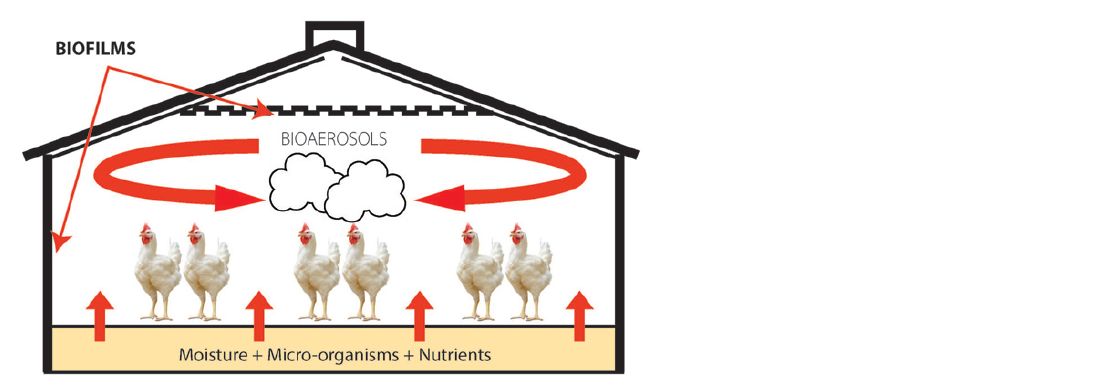
Partially controlled by ventilation, bio-aerosols play an important role in the spread of pathogens amongst animals and in the transmission of infectious agents between the buildings in livestock farms.
In the presence of animals, micro-organisms carried by bio-aerosols can become pollutants under three conditions:
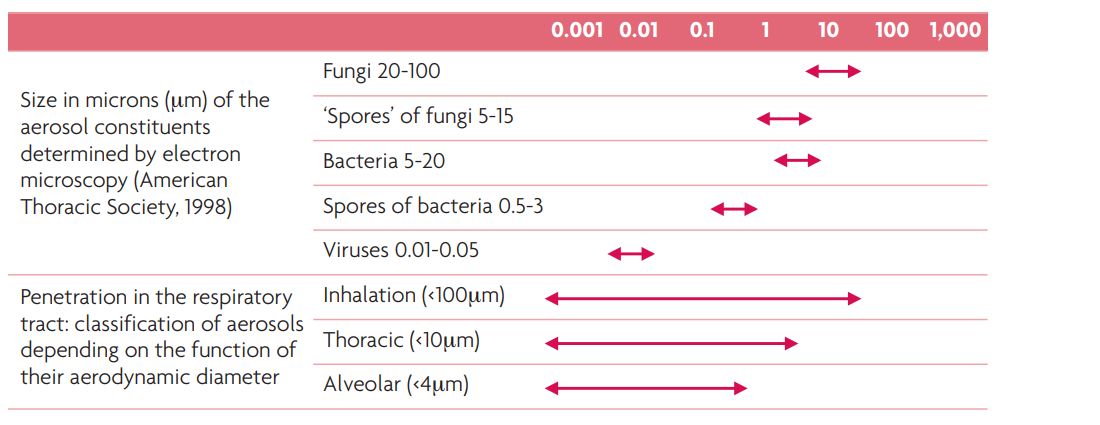
Bio-aerosols constitute an active part of what we commonly call infectious pressure. Given that the dynamic bacterial pool is maintained by the high concentration of organic matter and the heat and humidity in the barn, levels of infectious agents in aerosols are directly proportional to the number and concentration of animals in the farm or the facility (herd size, density) or in the region (population density).
Measurements in livestock farms refer to the number of bacteria per a total of 104 CFU/m3 air, and of moulds per 103 CFU/m3 versus the average values per 108-109 bacteria/cm3 for surfaces.
Enveloped viruses (for example avian influenza virus) are hydrophobic and show better survivability in dry air (RH < 50 - 70 %). Non-enveloped viruses (for example foot-and-mouth virus) are more stable in humid air. The foot-and-mouth disease virus is known to be transmitted by air, particularly in temperate zones (over distances of up to 60 km overland and 300 km offshore).
The temperature-related effect depends on the structure of micro-organisms. Bacterial concentrations carried by air are higher in winter than in summer.
The effect of dilution through ventilation on aerosol concentrations seems obvious, but it also causes an accelerated extraction of aerosol particles from letters and manures. The effect of ventilation is highly dependent on the characteristics of the ventilation system and on the design of the building.
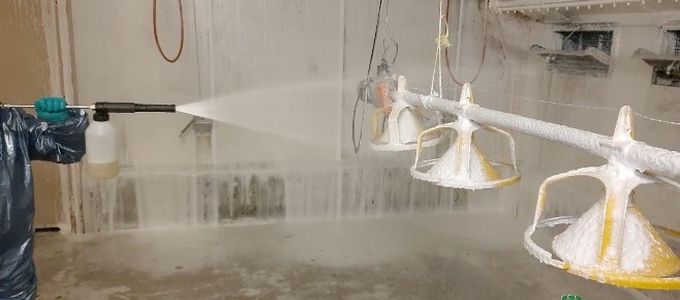
Airborne disinfection (nebulisation and thermal fogging) involves a device which propogates the product over some distance. Air is the vector of the product, whilst in contact disinfection, the product is applied directly to the surface by spraying.
In Europe, the efficiency of the method is evaluated for specific products and equipment according to EN 17272 standard.
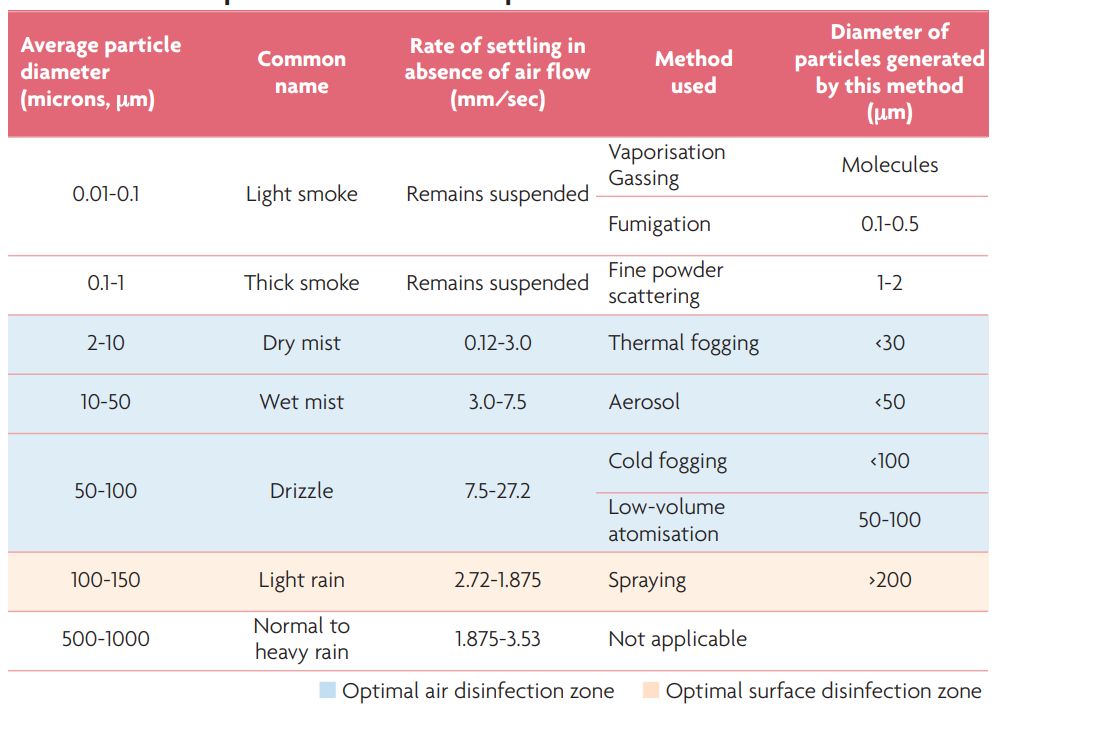
A specific volume can be subjected to disinfection by thermal fogging in an optimal manner using dry mist consisting of particles with a diameter of less than 30 microns. Nebulisation (cold fogging) gives rise to particles with a diameter of less than 100 microns (Table 2).
Glutaraldehyde and quarternary ammonium-based formulations are intended for use by spraying (first disinfection), nebulisation or thermal fogging in empty buildings (during the sanitary break period).
Vulkan Air, a new formulation developed by Huvepharma, is designed particularly for poultry farms. The concentration ratio between glutaraldehyde and quarternary ammonium compounds is in favour of glutaraldehyde. As such, Vulkan Air has a perfect diffusion in the air does not leave greasy deposits on the treated surfaces and demonstrates high effectiveness by thermal fogging and cold nebulisation: bactericide, virucide, yeasticide at 0.75 ml/m3, fungivide (Aspergillus niger) at 1 ml/m3, according to EN 17272.
Recently, Huvepharma also developed a disinfectant composed of peroxide and lactic acid synergised with essential oil: Aeroclean.
Aeroclean is a new generation disinfectant that can be used by aerial diffusion in livestock buildings, in hatcheries, in the food industry and in general disinfection. Its original formulation allows application in the presence of animals. The product represents one of the best innovations in airborne disinfection, formulated with a view to reducing risks to the environment, its users, and the animals and exhibiting a broad-spectrum efficacy against viruses, bacteria and fungi which create airborne contagion in livestock farms.

The Huvepharma® distribution network covers 90 countries in 6 continents. Please select a country from the list below to see the products and services available in that region.
To view all products and services, select Global from the dropdown menu or click .
Huvepharma has a remarkable distribution network which covers 90 countries in 6 continents. To offer you the best services, we ask you to select your country.
Update your browser to view this website correctly. Update my browser now