



global presence
Local support from a global company
Huvepharma® has a distribution network which covers more than 90 countries in 6 continents. Find your nearest Huvepharma® representative today.
Find your local contact


Swine dysentery is still one of the most important diseases in the modern pig industry worldwide. Infections with Brachyspira hyodysenteriae have a significant negative impact on several technical parameters such as daily growth, feed conversion and mortality rate and result in increasing treatment costs.
Furthermore, infected pigs are difficult to market because of the high risk of spreading further. For decades, the long survival time of the pathogen in the surrounding environment and the asymptomatic carriers pose a real challenge to deal with this enteric infection.
Therefore, eradication is the best option to overcome the subsequent high economic losses. Each eradication program should always be based on a combination of biosecurity and a medication program, both going hand in hand.
Symptoms
The clinical symptoms of dysentery in the pig shed, the farm history and the typical lesions at necropsy give a first indication of its presence. Easily recognisable symptoms of a B. hyodysenteriae infection are a bloody, mucoid diarrhoea together with a different consistency and colour of the faeces. However, blood is not always observed and a large number of pigs are even subclinically infected, showing no obvious symptoms at all.
The pathogenicity of B. hyodysenteriae depends on the virulence factors of the strain. The infection spreads slowly through the pen. When performing a necropsy, a fibrinic-necrotic infection of the large intestines with oedema of the mesenterium and swollen lymph nodes is observed, mostly accompanied by a bloody content.
B. hyodysenteriae is the most pathogenic of all spiral-shaped, haemolytic Brachyspira species with an anaerobe metabolism. Symptoms caused by B. pilosicoli are milder and are described as Porcine Intestinal Spirochaetosis. Recently, B. hampsonii was isolated, also demonstrating a significant impact on technical performance. Laboratory testing is required for a final confirmation.
Fresh faeces samples or large intestine tissue should be sent to the laboratory under anaerobe conditions in a well-stocked and sealed recipient immediately. Different laboratory techniques can be applied: culture on specific media, Polymerase Chain Reaction test, immunoflorescence and histopathology.
Any suspicion or postive diagnosis of 'haemorrhagic' colitis requires quick intervention of the pig veterinarian in order to reduce further economic impact. Antimicrobial treatment should be initiated as soon as the first symptoms occur.
Epidemiology
Pigs may appear clinically healthy after the initial treatment but, unfortunately, subclinical carrier pigs can excrete the organisms for more than three months after 'healing'. The organism is spread from faeces to mouth. Both pigs with clinical symptoms, as well as the above mentioned subclinical carriers, can introduce the disease on dysentery-negative farms by faecal shedding. Contaminated footwear and equipment transmit the infection easily. Brachyspira survives for several months in the faeces in the environment and in the manure under cold and wet conditions. However, in dry and warm environment, the survival time falls dramatically.
The period between the intake of the pathogen and the first clinical symptoms can vary from 10 days to three months. Hence, relapses are frequently observed in the field. Repetitive antimicrobial treatments are frequently initiated. However, medication alone is not sufficient to stop dysentery in the long run.
Taking into account this typical epidemiology, one can better understand why biosecurity is also crucial to control swine dysentery.
Biosecurity
Both external and internal biosecurity should be optimal and implemented before the start of an eradication program in order to reduce the risk of introducing the pathogen in a farm and to avoid further spreading within a positive farm. Planning ahead is key to stop the faecal-oral infection route successfully.
Eradication
Eradication is by far the most effective and cost-efficient way to improve technical performance, depending on the severity of the clinical symptoms. Each eradication protocol should be based on the farm-specific production system. Logically, indoor housing, multi-site pig production and batch farrowing systems increase the success rate. On the other hand, group housing of sows favours further spreading. A tailor-made program should be written down and all biosecurity measures and the exact instructions for treatment should be mentioned. The reason for each separate step of the protocol should be clearly explained to all the farm staff and evaluated on a regular basis.
As these bacteria do not like dryness and hot temperatures, summertime is the ideal season to install the program. There are three options to eliminate dysentery:
Total depopulation and repopulation
Total depopulation and repopulation with Brachyspira-free pigs after thorough cleaning and disinfection of the whole farm. The premises should be kept empty for at least two weeks. This is the most straight-forward method of disease eradication, but unfortunately it also means a high economic gap, due to cessation of production.
Eradication by strategic medication
The cash flow disruption is less with this alternative due to lower production losses and the maintenance of the genetic potential and parity profile of the sows. Diseased pigs should be removed from the herd before the start of the medication program. New animals should preferably not be introduced on farm during the treatment period.
After initial stabilisation of the symptoms of diarrhoea, the program requires an oral treatment of all sows present on the farm and the injecting of suckling piglets. An antimicrobial susceptibility test should be performed as a decreased susceptibility to some antimicrobials is sometimes noted. Most strains are sensitive to pluromutilines such as tiamulin (Vetmulin®, Huvepharma®).
The determination of the Minimal Inhibitory Concentration (MIC) of an antimicrobial for the detected strain of B. hyodysenteriae is a tool to check the susceptability. However, there is no standardised test method for Brachyspira and the results should be interpreted with care. Often, isolates showing an MIC result of less than 1 μg/ml are reported to be susceptible to tiamulin, whilst and MIC above 4 μg/ml is sometimes considered to indicate resistance.
Tiamulin reaches very high concentrations in the colon where Brachyspira infections occur and is classified by the World Health Organisation in the lowest level of importance for resistance development in humans. In case of decreased susceptibility, the synergistic combination of tiamulin with apramycin (Apravet®) or doxycycline (HydroDoxx® / Doxx-Sol®) can significantly lower the MIC values and improve efficacy.
During eradication, daily cleaning and disinfection should be performed. This higher biosecurity level and the antimicrobial treatment also facilitate the control of concurrent infections such as Mycoplasma. The treatment protocol can be summarised as shown in Table 1.
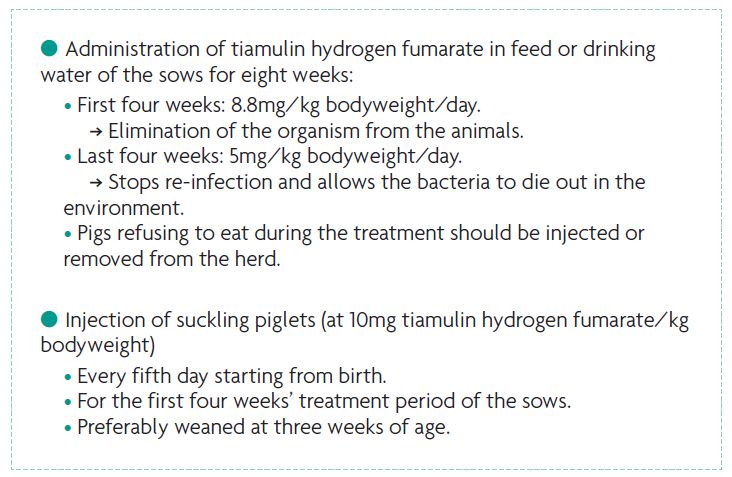
The main goal is to finally have negative progeny originating from a negative sow herd. Piglets born after the medication program of the sows are dysentery free and should always be transferred to perfectly cleaned and disinfected pens. Contact between 'clean' and 'dirty' compartments can never be tolerated, underlining once again the enormous importance of strict biosecurity. Cleaning tools marked with different colours can be used for specific pig houses.
Eradication by strategic medication can be performed in two ways:
Treatment of all animals present
The feasibility is detemined by the herd size.
Treatment
Huvepharma® has more than 60 years of expertise in fermentation and formulation of antimicrobial products, guaranteeing optimal efficacy in the field.
Vetmulin® (tiamulin) is presented in several formulations meeting the requirements of each field case:
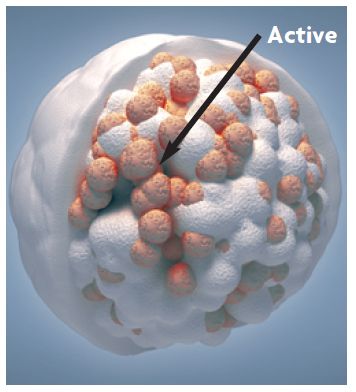
Tiamulin is a time-dependent antimicrobial resulting in improved effecacy when bacteria are constantly exposed to the drug. To guarantee optimal results, dosing should be based on bodyweight, regardless of the application form. Incorrect dosing is avoided by taking into account the changing ratio of bodyweight versus water or feed intake. Correct dosing can easily be achieved with the Huvepharma® dose calculator. This free-of-charge and handy application can be downloaded on all mobile devices.
Conclusion
Brachyspira eradication is the best option to improve the commercial feasibility of pig farms dealing with recurrent dysentery outbreaks. Therefore, a well-considered combination of different biosecurity measures and a strict antimicrobial therapy program should be initiated. With the full commitment of all the staff, elimination always results in a higher health status, improved technical performance and animal welfare, whilst reducing the repeated use of antimicrobials.
Huvepharma® is your reliable partner for advice on the control of dysentery and farm specific eradication programs.
This article original appeared in International Pig Topics Vol 34 No 6.

The Huvepharma® distribution network covers 90 countries in 6 continents. Please select a country from the list below to see the products and services available in that region.
To view all products and services, select Global from the dropdown menu or click .
Huvepharma has a remarkable distribution network which covers 90 countries in 6 continents. To offer you the best services, we ask you to select your country.
Update your browser to view this website correctly. Update my browser now