



global presence
Local support from a global company
Huvepharma® has a distribution network which covers more than 90 countries in 6 continents. Find your nearest Huvepharma® representative today.
Find your local contact


Two years ago Huvepharma spoke to Feedinfo about its hopes for Huvezym neXo, another of its enzymes developed and marketed under its new brand Huvezym. The brand includes a new range of products developed for efficient fibre degradation in animal production, with neXo, an enzymatic complex, positioned as a digestibility enhancer for monogastric species.
Much has happened in that two year period, with Huvezym neXo showing very strong performance in launch markets. Now, Huvepharma has been granted approval for use in the EU for all growing poultry, and is working to further extend the EU registration to laying hens and pigs.
In this Industry Perspectives piece, Feedinfo spoke to Huvepharma specialists Natalia Soares MSc, Global Product Manager Enzymes and Karel Bierman, Global Marketing Director Poultry about the initial development of the product and the company's growing understanding of fibre, as well as the reasoning behind its development of a complex of enzymes for fibre degradation. We also discuss future developments.
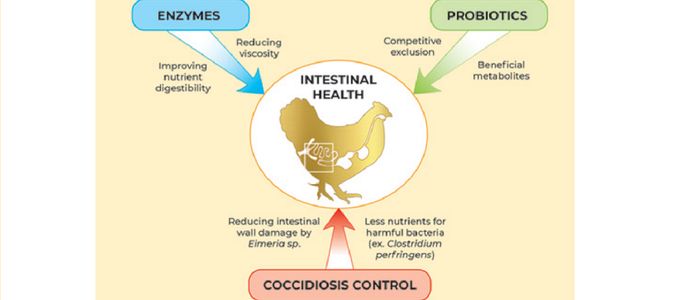
[Natalia Soares] Indeed, the development of Huvezym neXo is supported by several years of research about the mode of action of fibre degrading enzymes (FDEs) and the interactions between different enzymes when used in animal nutrition. The beneficial impact of FDEs in animal performance is made up of three main distinct mechanisms:
Part of our published research had a focus on understanding the fate of the released oligosaccharides and how it influences the digestive process and or health of the animal.
It can be said that Huvezym neXo derives from a clear scientific understanding of:
In addition, we were also able to validate in vitro models to assess the degradation of cell wall polysaccharides by fibre degrading enzymes and strategies to identify AXOS (arabinoxylan oligosaccharides) which are an important contribution for further development work.
[Karel Bierman] Let me say it in a simpler way: when looking at the feeds of monogastric species, a large part consists of carbohydrates. Fibre is a small part of it, but it is poorly digestible and hence does not contribute a lot to the digestible energy content of the feed. Fibre also has a hindering effect of the optimal digestibility of other valuable nutrients by trapping them in its complex matrix of different molecules.
For Huvepharma, the challenge was to develop an enzyme that could further improve nutrient digestibility by a more efficient breakdown of the fibre structure, especially when more complex fibre (i.e., more fibre-rich feed ingredients in higher amounts than currently fed) is present in the diet. By this, we bring more freedom to the nutritionists to formulate with a wider range of raw materials that will result in a lower feed cost.
We also wanted to scientifically demonstrate the mode of action of our FDEs which we were able to do in this research.
Our key findings:
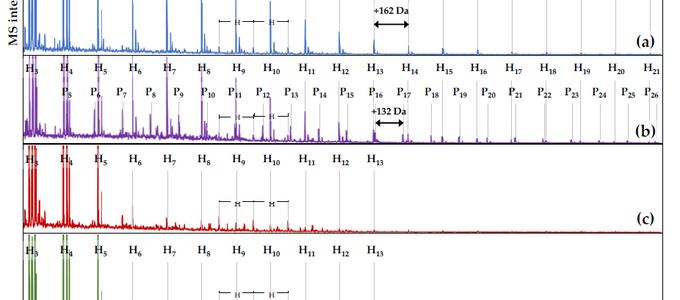
[Natalia Soares] Yes, as a result of our research with Wageningen University and Research we are able to publish different papers demonstrating the fibre degradation patterns and fate of degradation products along the animal GIT and how enzymes influence it. Basically, we sampled digesta from the gizzard, ileum, caeca and excreta of broilers fed different diets and enzymes and extracted and identified the fibre degradation products released by the action of the enzymes in the different GIT segments.
Overall, the findings allowed us to show that our enzymes improved arabinoxylan hindgut utilisation by showing an increased proportion of arabinoxylan becoming available for fermentation in the caeca, which is beneficial for SCFA formation and ultimately, for broiler health.
We could also show that the enzymes used in the research could depolymerise both soluble and insoluble arabinoxylan and release AXOSs in vivo.
We strongly believe that our work highlights the contribution of FDEs to broiler health and provides valuable insight on the utilisation of arabinoxylan and AXOS along the GIT. And we expect that the detailed oligosaccharide analysis in complex digesta will contribute to further progress in the study of carbohydrate fermentation in vivo, in the GIT of animals.
[Natalia Soares] Well said. Fibre is a very complex structure that varies significantly from feed ingredient to feed ingredient and within each feed ingredient. Understanding the fibre structure and its variations allows an informed choice of the most suited enzyme(s). From an animal nutritional business perspective, it needs to be understood that the most suited choice will be an enzyme solution that brings consistent results, independently of fibre variations or feed formulation. Here, it is important to be clear that all commercial FDEs will have different efficiency depending on multiple factors, with the substrate (feed) being of highest relevance.
"Taking the most out of it" becomes a compromise between science, nutrition and economic outcome.
From the Huvepharma standpoint, fibre is a complex of different molecules and its efficient degradation needs a complex of enzymes. Along with the accepted use of xylanase enzyme, other enzymes that may assist or support fibre hydrolysis are needed. Huvezym neXo reflects just that; an enzymatic complex, xylanase-based with an additional cellulase and a xyloglucanase to support efficient fibre degradation. The more complex the fibre structure gets, the more relevant and differentiated Huvezym neXo gets. This is when the product delivers its potential for "taking the most out of it".
[Karel Bierman] Enzymes are very specific in their action. An enzyme targets a specific binding site in one of the fibre molecules, and only breaks that particular bond. It is really like a key fitting on one type of lock only, however the key can be used repeatedly on the same type of locks. This means that if you choose an enzyme that does not match with the type of bond present in the fibre you are targeting, the enzyme is not doing anything.
It is not only about matching the enzyme with the bond, but also the accessibility of the bond. Again, the comparison with key and lock. If you want to open a lock and you have the right key for it, but the lock is inside a house which is locked too, you first need to have another key to open the house before you can open the lock inside the house.
Because fibre is indeed widely variable, a broader acting enzyme, instead of an enzyme with just one single activity, will have a better and more consistent effect in practical formulated feeds. Here is where Huvezym neXo makes a difference with existing enzymes in the market, it brings three different key enzyme activities (xylanase, xyloglucanase and cellulase), capable of improving digestibility of a broad range of feed ingredients.
[Karel Bierman] No, we do not see that less grains are being used in feeds. Grains are a basic ingredient for monogastric feeds, mainly for supplying energy. In a market where prices of grains will go up, normally also the fat market will go up, so in general the energy component in the feed will get more expensive.
When a component gets more expensive, you have to make better use of that component, by improving its conversion rate. It is the same as with gasoline in a car. When gasoline gets more expensive, you are not putting less gasoline in your car; you try to drive more economically and so do not spend more money per kilometer driven. This type of situation is exactly where enzymes can help, improving efficiency of use of the energy components in feeds and at the same time contributing to more sustainable production.
[Natalia Soares] Huvezym neXo is now a nutritional tool available in several countries where complex fibre diets are key. We are positive about its results, highlighting Asia where formulations are traditionally based on complex fibre diets, meaning we can show Huvezym neXo's uniqueness.
Huvezym neXo has shown high efficiency in all commercial trials run with broilers, layers and piglets using complex fibre diets, such as formulations with maize, barley, cassava, soybean, palm, rich and byproducts. in such formulations, performance improvement, when compared with a control diet without enzyme, ranged from 4% to 8% (measured as body weight and FCR), depending on the species and the trial conditions, stressing that such results were seen in animals under good performance standards. As said before, we are bringing a new nutritional tool for optimal fibre degradation - as the fibre challenges in the diet increase, so does the impact of Huvezym neXo.
[Karel Bierman] We are launching Huvezym neXo now in the EU. We have received approval of the enzyme for its use in all growing poultry, so the EU industry can now incorporate neXo into rations and start saving costs in a challenging raw material market.
Feed formulation within the EU varies significantly, from maize-soybean diets to wheat-soybean and all possible formulations using barley, rapeseed meal, sunflower meal, hybrid rye (which is gaining interest in some markets) and a divesity of byproducts. We expect customers to take Huvezym neXo as their nutritional tool to safely optimise feed formulations and be able to use alternative raw materials or higher amounts of an otherwise capped raw material, reducing feed costs without compromising animal performance. This premise fits both poultry feed commercial mills and integrators.
[Natalia Soares] For sure R&D work continues, not only towards FDEs but to broaden the Huvepharma enzymes portfolio. We have managed to reach a leadership position in the feed enzymes market and it is our responsibility to keep researching and developing the most efficient and cost effective solutions and bring these to market. The development pipeline has several running projects that, when released, will bring more and different tools for positive promotion of efficient animal production.
[Karel Bierman] Our R&D team is continuously looking for new enzymes to benefit the industry. For Huvezym neXo we are also working to further extend the registration in the EU for laying hens and pigs, which is ongoing, and we will keep our focus in the rollout of neXo all over the world. We are confident that Huvezym neXo opens up new opportunities for our customers to formulate feeds with more fibre-rich ingredients while maintaining high animal performance and health standards.


The Huvepharma® distribution network covers 90 countries in 6 continents. Please select a country from the list below to see the products and services available in that region.
To view all products and services, select Global from the dropdown menu or click .
Huvepharma has a remarkable distribution network which covers 90 countries in 6 continents. To offer you the best services, we ask you to select your country.
Update your browser to view this website correctly. Update my browser now