



global presence
Local support from a global company
Huvepharma® has a distribution network which covers more than 90 countries in 6 continents. Find your nearest Huvepharma® representative today.
Find your local contact


In swine production the use of antibiotics is an integral part of a swine health plan. For each farm unit, a health plan is designed and includes health monitoring, disease diagnosis, disease prevention and disease treatment measures.
The most common and important enteric infections in the ileum and colon are the following:
When pigs are challenged by PPE, SD or PCS the most important consideration must be to quickly control the disease with an appropriate treatment. Different antibiotics are licensed for therapeutic use against Lawsonia and Brachyspira infections in pigs.
No suitable protective vaccines against B. hyodysenteriae and B. pilosicoli are available commercially. In the case of L. intracellularis, currently an inactivated Lawsonia vaccine and a live attenuated vaccine can be used for PPE prevention.
Responsible use of antibiotics and AMR
Sustaining antibiotic efficacy in the long term is critical and demands the responsible use of antibiotic therapies. The targeted use of antibiotics aims to limit the development and the expansion of antimicrobial resistance (AMR).
The animal health and production industries play a significant role in minimising AMR risk. Following internationally endorsed recommendations summarised in the '5Ds' of antibiotic stewardship is the basis for AMR minimisation.
Considerations when using antibiotics
Selecting the best antibiotic depends on the therapeutically effective concentrations that the antibiotic achieves at the gut infection site and the susceptibility of L. intracellularis / B. hyodysenteriae / B. pilosicoli strains to the antibiotics registered. Use of a drug with broader spectrum can be beneficial based on different bacteria organisms possibly present in the ileum and colon based on polymicrobial infections.
When selecting the appropriate type of antibiotics for PPE, SD or PCS treatment, it is vital to look at two different antibiotic characteristics, both of which are essential for treatment justification. They must have:
Favourable MICs
Limited data on the in vitro sensitivity of L. intracellularis strains to antibiotics are available. This is due to the difficulty of isolating and maintaining L. intracellularis from faecal or intestine samples and the need to use complicated cell culture systems to evaluate antimicrobial activity in vitro. The in vitro sensitivities of L. intracellularis strains from important pig production countries are shown in Table 1.
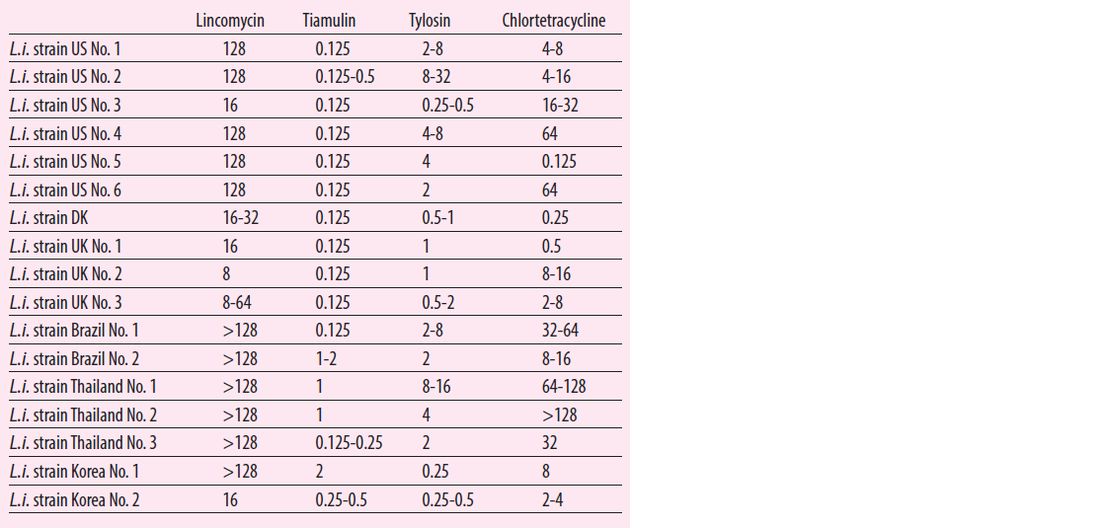
The MICs evaluate the L. intracellularis antimicrobial susceptibility in four different important pig production regions worldwide. The intracellular MICs were determined to measure the effect of the antibiotics on L. intracellularis when the intracellular organisms were inside the enterocytes. The intracellular MIC results show that tiamulin is the most active compound against the tested L. intracellularis isolates. Tylosin shows intermediate activity and lincomycin is the least active compound with high MICs. High MIC variation was determined for chlortetacycline.
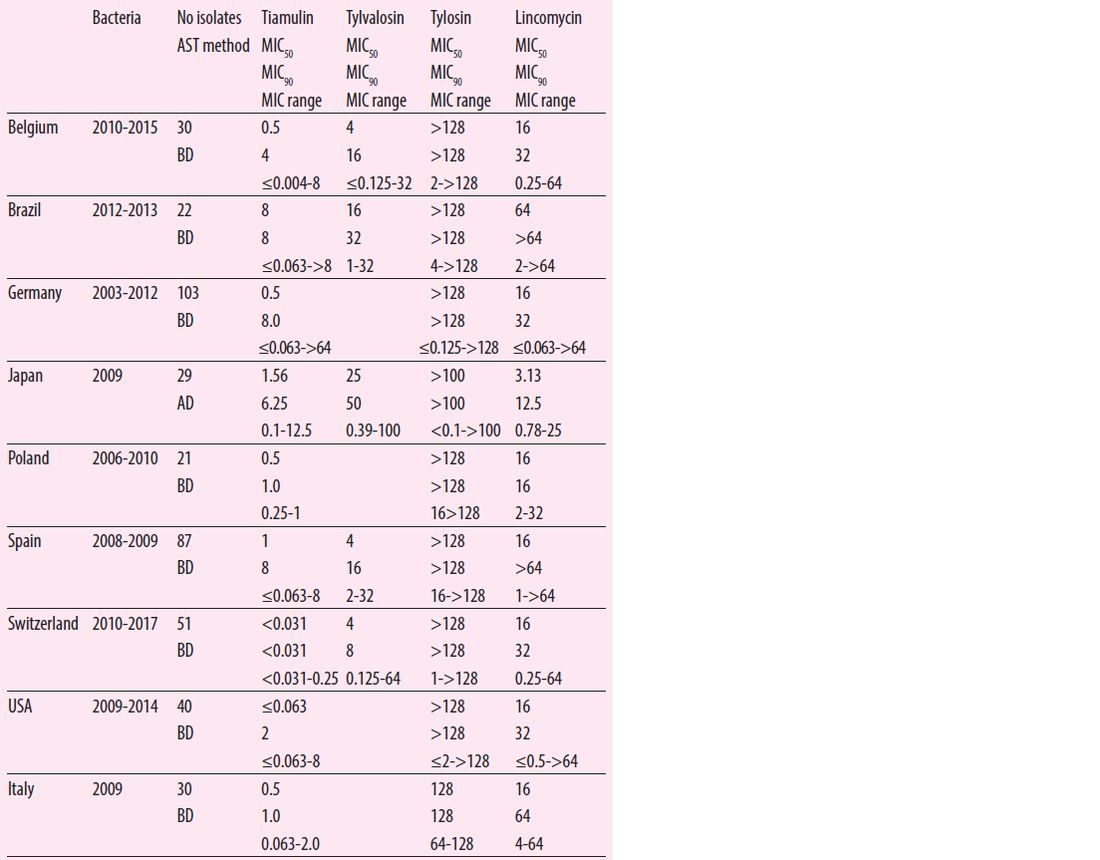
Sensitivity tests with B. hyodysenteriae strains are conducted routinely worldwide in several institutes with experience in Brachyspira culturing, isolation and MIC testing. In Table 2, results of MIC investigations on the use of broth microdilution method (one study use of agar dilution) are summarised. In the majority of the countries, low MIC values and high susceptibility to tiamulin was found. In contrast, most Brachyspira isolates show low susceptibility to lincomycin and tylosin with constantly high MICs. B. hyodysenteriae isolates displayed heterogeneous susceptibility to tylvalosin with moderately high MICs.
Pharmacokinetics
Once the MIC against L. intracellularis and B. hyodysenteriae strains is determined, it is necessary to relate the MIC data to the PK characteristic of the antibiotics. The relation allows vets to assess if effective therapeutic concentrations can be achieved at the ileum and colon infection site. In Table 3, the colon content concentration (CCC) and ileum content concentration (ICC) of different antibiotics achieved after in-feed treatment at registered dose levels is summarised.
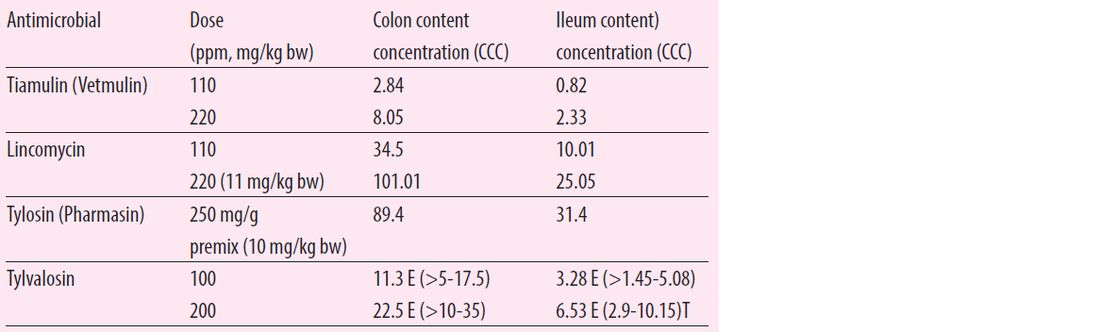
The published data show a rather linear relationship between the in-feed concentration and found CCC and ICC of the antibiotics. Tiamulin achieves relatively low concentrations in the colon and ileum in comparison with lincomycin and tylosin. Concentrations of tylvalosin in the colon and ileum are in between after in-feed medication.
PK/PD analysis demonstrates differences between the three drugs and their likely potential to inhibit ileitis infections. A strong treatment effect against ileitis can be expected at ICC of the drug after oral administration at or above the intracellular MICs. This is the case for tiamulin (tiamulin ICC 2-18 times above the MIC) and for tylosin (tylosin ICC 1-125 times above the MIC). In the case of lincomycin, a prediction of the treatment effect cannot be given after oral administration based on much lower lincomycin ICC versus the determined lincomycin MICs.
PK/PD differences of the four drugs are important to consider for the decision on what antibiotic to select for SD treatment. For prediction of successful treatment against SD, the CCC of the drug needs to be at or above the MIC50 and MIC90 values. This is the case for tiamulin at both dosage levels tested. High lincomycin MIC50 and MIC90 values predict a therapeutic effect only at the higher tested dose. A treatment effect of tylosin is unlikely based on tylosin MICs greatly in excess of tylosin CCCs achieved. Tylvalosin CCCs at two treatment levels are in between MIC50 and MIC90 values. A therapeutic effect is likely to be achieved at lower MICs.
Conclusions
Susceptibility testing, knowledge of antibiotic pharmcokinetics and targeted use of antibiotics are effective tools to limit development and expansion of AMR. Antibiotic drug PK/PD profiles help to identify the best dosing regimes for enteric infection treatments. These PK/PD concepts are the basis for therapeutic success, for distinct reduction of B. hydysenteriae and L. intracellularis levels to avoid SD/PPE reinfections in the next production phases and for dose optimisation which helps to prevent therapeutic failures.
References are available on request.
This article originally appeared in Pig Progress Vol 36 No 3.

Tylovet® is our tylosin product. Typically supplied as a phosphate for use in premixes, a tartrate for water solubles and a base for the injectable form.

The Huvepharma® distribution network covers 90 countries in 6 continents. Please select a country from the list below to see the products and services available in that region.
To view all products and services, select Global from the dropdown menu or click .
Huvepharma has a remarkable distribution network which covers 90 countries in 6 continents. To offer you the best services, we ask you to select your country.
Update your browser to view this website correctly. Update my browser now