




global presence
Local support from a global company
Huvepharma® has a distribution network which covers more than 90 countries in 6 continents. Find your nearest Huvepharma® representative today.
Find your local contact


In the past, there was little interest in the assessment of calcium (Ca) requirements in poultry diets. This was due to the availability of cheap limestone, which accounts for 80-85% of the total Ca in feed. However, driven by the numerous studies of the effect of Ca on phosphorus (P) digestibility and phytase efficacy, the impact of Ca on performance has gained increasing interest.
Research from recent years has indicated that oversupplying Ca can negatively affect animal performance:
Inhibition of phytase on phytate degradation due to Ca
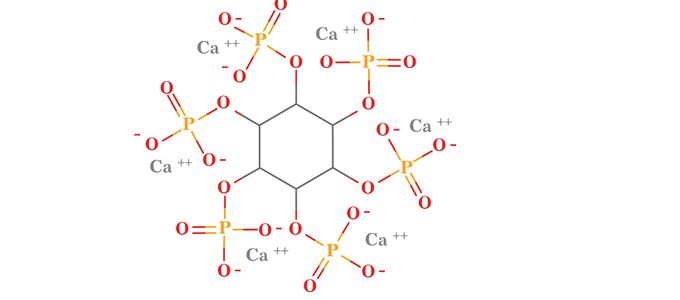
Dietary Ca forms complexes with phytate and these complexes can remain insoluble at a high pH (Figure 1).
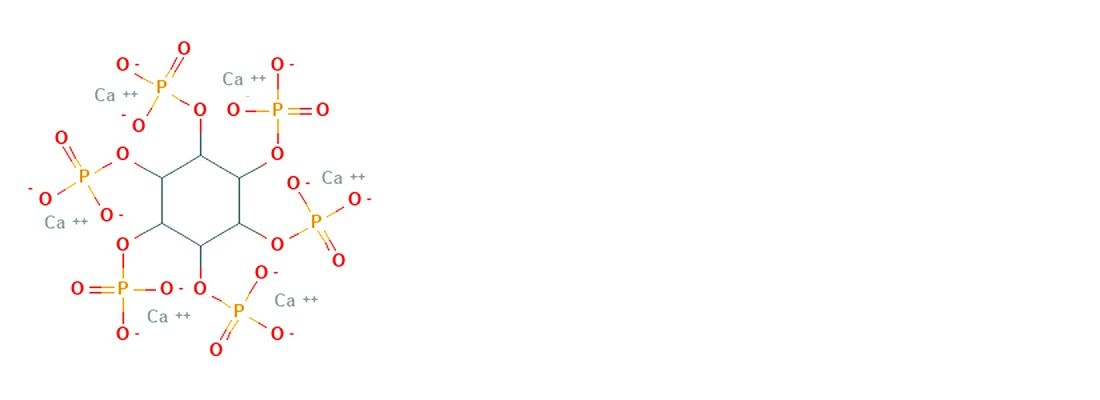
These precipitated phytate-Ca complexes are not accessible for hydrolysis by a phytase and this reduces the amount of P released. Therefore, an excess of Ca will reduce the P digestibility. Moreover, the speed of the limestone solubilisation will dictate the concentration of Ca available to chelate with the phytate. Fine limestone is in general more soluble than coarse limestone, meaning it will bind faster to phytate. As a result, it has a stronger negative impact on P digestibility compared to a coarse limestone.
Ca and P need to be in balance
Lowering the Ca levels in feed would be advisable to improve P digestibility, besides the choice of a coarser limestone. However, absorbed P can only be retained in the bones when enough Ca is present at blood level to form hydroxyapatite (bone mineral). Lowering the Ca level will improve P digestibility, but due to the lack of Ca to retain the absorbed P, the P level in the bones can still be low. Deficiency of Ca can therefore cause poor bone quality, even when P digestibility is improved by lowering the Ca level. This indicates that an uncontrolled lowering of the Ca levels in the feed can also reduce the birds' motility and thereby performance.
A broiler study
A practical example has been demonstrated in a recent 35-day broiler trial at the University of Warmia and Mazury, Poland.
Feed was reformulated with 1,000 FTU/kg of a novel intrinsic heat stable phytase (OptiPhos Plus), only using its corresponding P matrix value, while and NSPase complex (Hostazym X) was added on top. Two different Ca treatments were imposed:
The overall technical performance was very good (EPEF > 500) showing the impact of the enzymes on securing a high broiler performance.
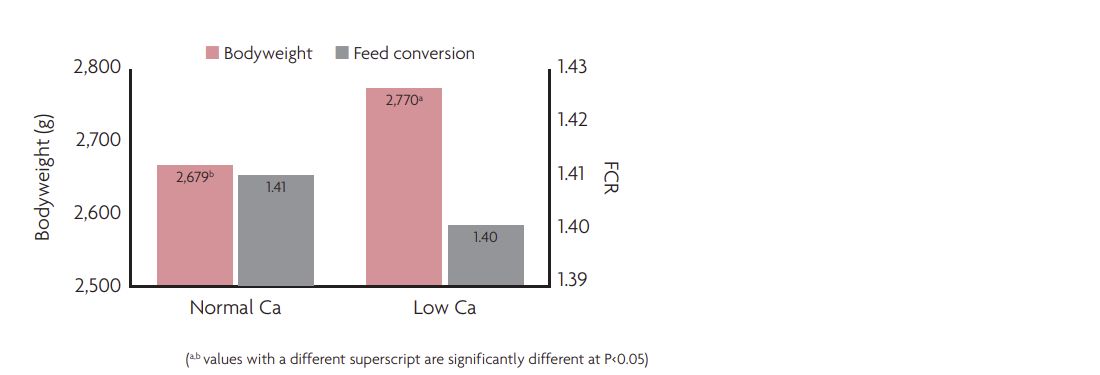
The following effect of Ca could be noted:
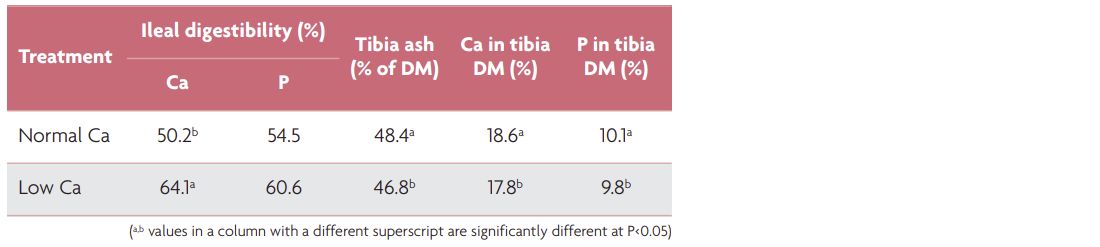
The fact that low Ca levels optimised technical performance and improved P digestibility, but reduced bone ash, demonstrates that too low Ca levels will lead to too low Ca levels at blood level, and therefore result in inefficient bone formation. This also indicates that there is a higher Ca requirement for optimal bone growth compared to what is required to optimise performance.
Conclusion

Hostazym® X is a unique and highly efficient fibre degrading enzymatic complex, with proven efficacy in increasing the nutrient digestibility of animal diets, resulting in better zootechnical performance and contributing to a healthier gut environment.

OptiPhos® Plus is the latest generation, most thermostable phytase on the market. OptiPhos® Plus has improved thermostability and shows robust and reliable matrix values.


The Huvepharma® distribution network covers 90 countries in 6 continents. Please select a country from the list below to see the products and services available in that region.
To view all products and services, select Global from the dropdown menu or click .
Huvepharma has a remarkable distribution network which covers 90 countries in 6 continents. To offer you the best services, we ask you to select your country.
Update your browser to view this website correctly. Update my browser now